Runner’s guide Understand your training
Read Fitness and Energy
Progress separates longer-term fitness from how demanding today may feel. Open Trends for the overall picture or Weeks to look back at individual weeks.
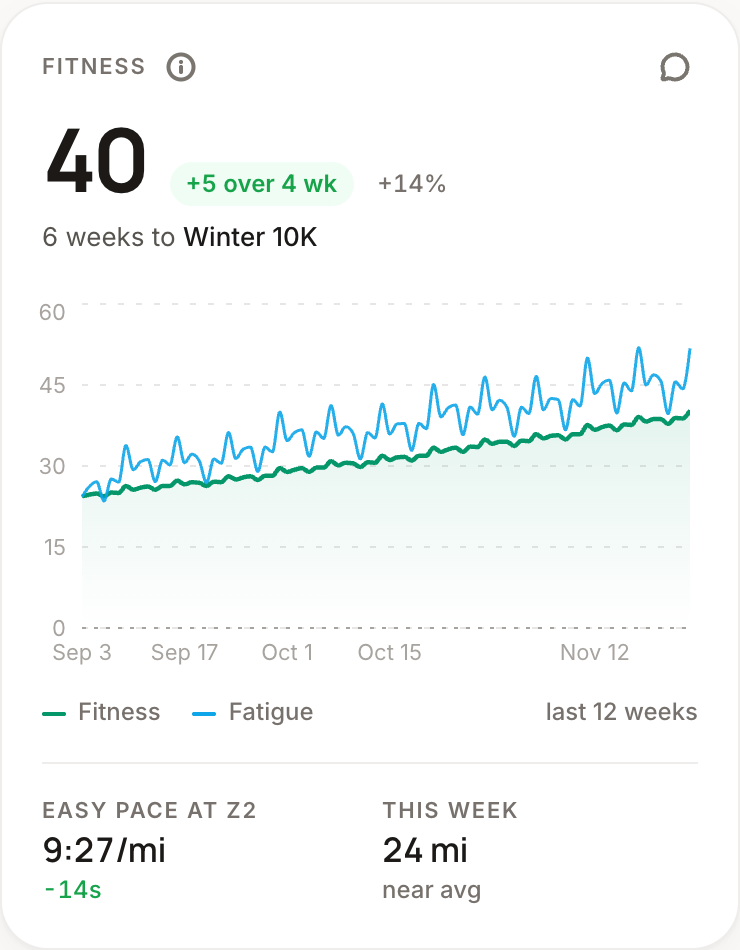
Read Fitness
Fitness uses a 42-day weighted average of training load. Longer or more intense runs generally add more load. Fatigue uses a faster seven-day average. Form compares the previous day’s Fitness and Fatigue, so a hard week can raise Fitness while leaving you tired.
The load calculation prefers a heart-rate distribution when available, then workout-average heart rate, then pace relative to your threshold. A duration-based estimate fills the gap when those inputs are missing. Comparing the trend across your own weeks is more informative than comparing numbers with somebody else.
Read Energy and check in
Open Today to report how you feel: Great, OK, Flat or Sore. Energy combines recent training with available recovery readings, such as sleep, resting heart rate and HRV. It explains the reasons behind Ready, Normal, Go easy or Rest. Without usable recovery readings, it falls back to training information and your check-in.
For example, a Flat check-in after 4h 45m of sleep can be a reason to revisit a planned quality session. Read the explanation. If Today offers an easier session, Swap it changes the workout and Keep my plan keeps the original. The indicator cannot determine injury or illness.
Read the six training signals
- Weekly volume
- Compares recent distance with your usual volume over completed weeks.
- Easy share
- Shows how much recorded heart-rate time was in easier zones. A blank can mean there was too little heart-rate data.
- Long run
- Counts recent weeks containing a run classified as Long Run.
- Quality sessions
- Counts harder sessions across recent weeks.
- Aerobic efficiency
- Looks for a change in speed relative to heart rate on comparable, relatively flat easy runs.
- Gray zone
- Shows the share of easy-type runs classified as Moderate during the last four completed weeks.
Open the evidence behind a signal before changing your training. A dash can mean Lope needs more history or more comparable runs. For example, aerobic efficiency requires runs in both comparison periods.
Find the right number
Fitness and Energy are different from the four training scores. Those scores describe specific training qualities and can be weighted for a race goal. Progress also offers a week-by-week view for checking which sessions produced a change.